
Keeping the canals flowing, and what to do with the muscle salmon you remove
Every autumn, muscle salmon (kinjake) swim up from Tenkyōgen.
The muscle salmon is a fish found only in Tokomizu. It climbs the great waterfalls on its back, powered by its well-developed pectoral fins and tail. Its body, however, is broad, and it is poor at changing direction, so it sometimes gets stuck at bends and narrow places in the town's canals.
If you find a muscle salmon blocking the flow of a canal, please remove it as described below. Muscle salmon you remove may be taken home for your household to eat, within the set limits.
Just because the head fits does not mean the body will.
What Is a Muscle Salmon?
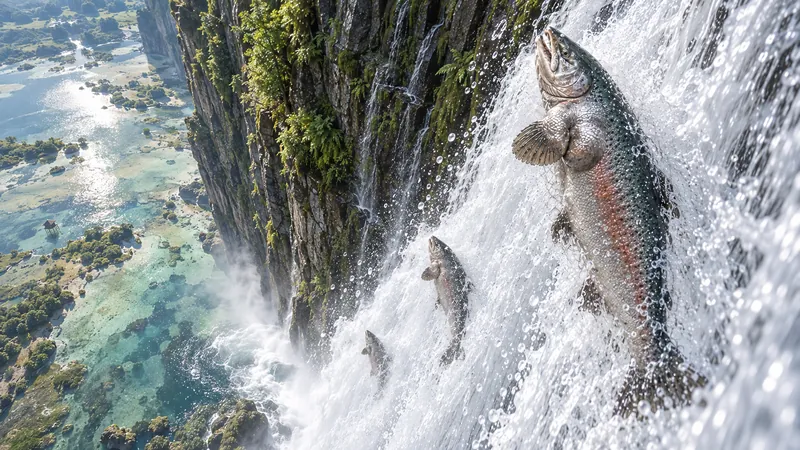
| Habitat | The fairways of Tenkyōgen and the plunge pools at the foot of the Oyasu cliffs |
|---|---|
| Adult length | Generally 80–110 cm |
| Appearance | Silver scales, a thick back, a broad tail base and remarkably well-developed pectoral fins |
| Diet | Small crustaceans and aquatic insects |
| Purpose of the run | Spawning in the cold spring-fed canals of Oyasu |
| Swimming style on the run | Backstroke: it climbs head-up, with its back to the waterfall and its belly facing out |
| Temperament | Gentle, but it does not readily change direction |
On the run, it turns its back to the waterfall and, working its pectoral fins and tail, swims up against the current in an almost straight line. Climbing a great waterfall by backstroke is an ability unique to the muscle salmon.
The ability to climb a great waterfall by backstroke does not guarantee the ability to get round a bend in town.
When a Muscle Salmon Needs to Be Removed
Removal is needed in the following cases.
- Its body or pectoral fins are wedged between both banks, and it cannot move forward or back.
- It has stopped at a bend, and fallen leaves and branches are piling up on its upstream side.
- The water is rising upstream of the fish, and the flow downstream has weakened.
- It is wedged in a sluice or water intake and is blocking the flow.
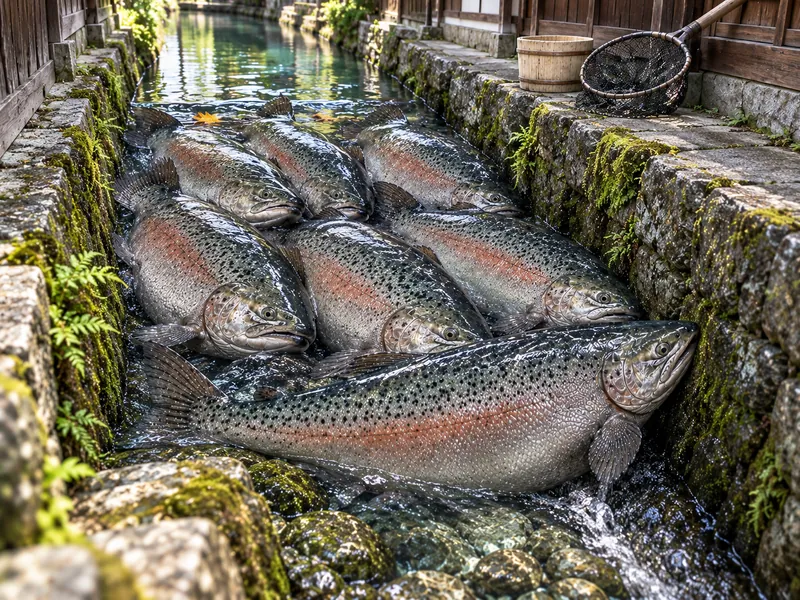
Fish resting in wide places, or swimming without difficulty, do not need to be removed.
Please do not judge from a muscle salmon's expression whether it needs help. It wears almost the same face whether it is fine or stuck.
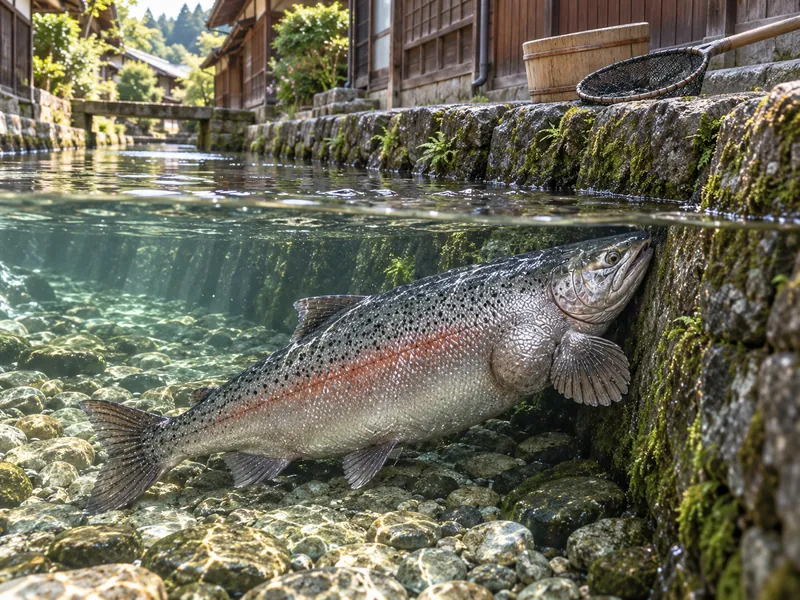
How to Remove a Muscle Salmon
1. Check the water
Check the water level, the strength of the current and your footing. Do not work where you cannot keep a firm footing, such as inside sluices or near waterfalls; tell the water warden instead.
2. Get your tools ready
Have a wide, sturdy landing net and a tub big enough to hold the fish.
Muscle salmon can be heavier than they look. Check the size of the tub before you lift.
3. Ease the body back
Support the belly with the landing net and ease the fish back, little by little, the way it came in. If a pectoral fin is caught, free it from the bank before moving the body.
Do not use the pectoral fins as handles.
Do not pull it by the tail alone, and do not push it further into the bend.
4. Move it to the tub and check the canal
Support the whole body and move it into the tub. Once it is out, clear away the fallen leaves and branches that have built up, and check that the water is flowing.
If fish get stuck in the same place again and again, please tell the water warden where, so that improvements to the canal can be considered.
Limits on Taking Fish Home
To prevent overfishing, please keep to the following limits when taking removed muscle salmon home.
| Category | Limit | Procedure |
|---|---|---|
| Households | One fish per household per week | No notification needed. Please record the date you took it home |
| Restaurants | Three fish per registered restaurant per day | Prior notification and a collection record are required |
For households, a “week” runs from Monday to Sunday. Members of the same household may not each take one fish home. Unused limits cannot be carried over to the next week.
The limit applies to how many fish you may take home. It does not limit the removal work needed to keep the canals flowing.
Please hand any muscle salmon removed after you reach the limit to the water warden. Live fish will be moved, depending on their condition, to wider canals where they can continue their run. If a fish is put back just upstream of where it was removed, it may get stuck in the same place again.
Narrowing canals in order to catch fish, or deliberately making muscle salmon get stuck with boards or stones, is prohibited.
Notification for Restaurants
To use removed muscle salmon at a restaurant, please submit a Muscle Salmon Collection Notification.
The notification must include the following.
- The restaurant's name and address, and the name of the person in charge
- The canal or district where fish will be collected
- The container used to carry the fish and where they will be stored
- The main ways the fish will be cooked
Collection records must include the date, the place and the number of fish.
The limit under the notification is three fish per day for the whole restaurant. There are no additions for the number of staff, the number of seats or the thickness of the pectoral fins.
Delicious Ways to Eat Muscle Salmon
Muscle salmon has thick layers of flesh that come apart in large flakes when cooked. The thick back is good for grilling, and the base of the pectoral fins is good for simmering.
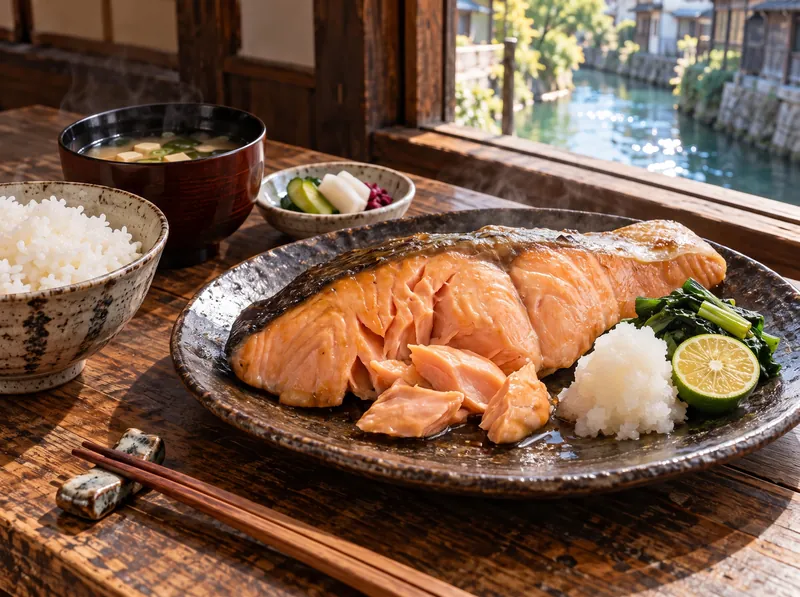
Thick-Cut Miso-Grilled Muscle Salmon
Ingredients (serves 2)
2 muscle salmon fillets, 2 tbsp miso, 1 tbsp mirin, 1 tbsp sake.
- Pat the fillets dry.
- Mix the miso, mirin and sake, and spread a thin layer over the fillets.
- Leave in the refrigerator for about 30 minutes, then lightly wipe off the miso on the surface.
- Grill over a fairly low heat until the thickest part is cooked right through to the centre.
Serve with grated daikon or citrus to enjoy the toasty miso and the sweetness of the flesh.
Do not judge by the colour of the surface alone. A muscle salmon goes deeper than you think.
Pectoral Fin Base Simmered with Daikon and Ginger
Simmer the thick base of the fins with daikon, ginger, sake, soy sauce and mirin. Remove the bones and fins as you go, and enjoy the flaked flesh.
We recommend using the fin base too, but there is no need to keep the shape of the muscles when serving.
Muscle Salmon and Mushroom Rice
Flake the cooked flesh, remove the bones, and cook it with mushrooms and rice. Divide anything you cannot finish at once into portions and store it.
There is no obligation to finish a whole fish on the day you remove one.
Frequently Asked Questions
- It isn't moving, and it's looking at me. Is it angry?
- You cannot tell from its expression alone. First, check whether its pectoral fins and body are wedged against the banks.
- If it can climb a great waterfall, can't it get itself out?
- Moving upwards and turning sideways are different abilities.
- I removed it, and it came back to the same place.
- It may be the same fish. If it gets stuck repeatedly, please hand it to the water warden.
- If I take only half a fish home, does it count as half?
- Even if divided, it counts as one fish.
- Our family has grown. May we take two fish home just this week?
- There are no additions for household size. Please share one fish.
Contacting the Water Warden
In the following cases, do not do the work yourself; tell your district's water warden.
- Several muscle salmon are stuck at once.
- The water level is rising suddenly.
- The fish is near a sluice, a culvert or a waterfall.
- It will not fit in your net or tub.
When you get in touch, please tell us the place, the number of fish and the state of the water flow. There is no need to report the fish's expression.