
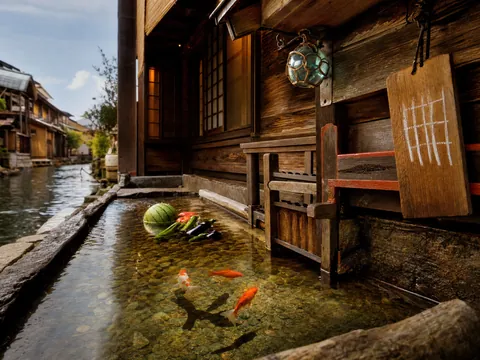
The canals of the town are still used today for daily life, transport, firefighting, farming and more.
There are 808 canals in all: 8 great canals, 4 ring canals and 796 small canals, about 220 km in total. Because the water that wells up from Mount Mizufuji never runs out, the canals have long been the most useful tool in the town.
What the Canals Do
| Name | Role | How to recognise it |
|---|---|---|
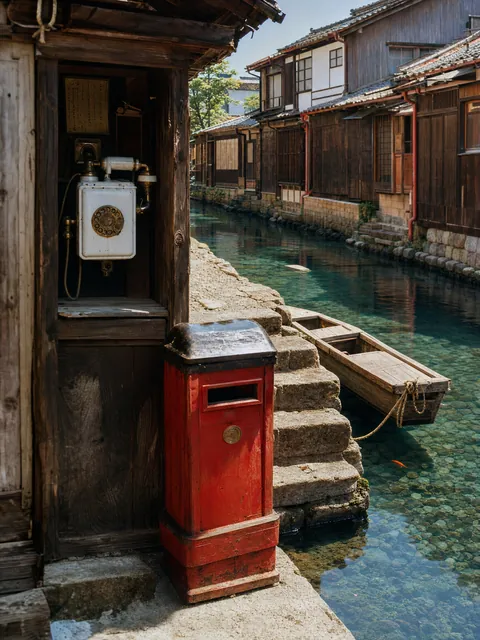
| Boat-mail canal | Carries people and letters | Boat-mail posts, mooring posts, wooden signs at the landings |
| Cargo canal | Carries goods | Wide, with pulleys for unloading |
| Cooling canal | Keeps houses cool | A narrow canal running under the floor or beside the rooms |
| Firefighting canal | Water for fighting fires | A vermilion fire sluice at every crossing |
| Wheel canal | Makes electricity with water-wheels | Water-wheels and brass generators |
| Sunlit canal | Lets sunlight reach the goldfish | Open to the sky and clear to the bottom |
| Field canal | Carries water to the fields | Wooden dividing boxes, medaka fish |
| Kitchen spring (kabata) | Washing up and keeping food cool | A water box brought into the kitchen |
| Shrine canal | The sacred ground of a shrine | Sacred rope, shrine koi |
No Roads for Cars
There are no roads for cars in Tokomizu Town. People walk along lanes, stone paving, stepping stones, bridges and paths on the canal banks, and use canal food-boats and circuit boats (town ferries) to go further.
At the Crossings
Where canals cross, you will find a boat-mail post, a canal signal, a ceramic public telephone and a water clock. A canal signal shows blue when its glass globe fills with water and red when it empties.
- Canal and transport information(Japanese)
- Keeping the canals clean (the Draining)(Japanese)