
Mizutome Shrine stands on a hill about 25 m high on the north shore of the Ring Lake in Kamimachi. Local people call it Mizutome-sama. In the grounds, spring water from the top of the hill passes through the purification pavilion, runs down a canal beside the approach and returns to the lake. Every autumn, on the day before the Draining in Kamimachi, the Mizunuki Festival is held here.
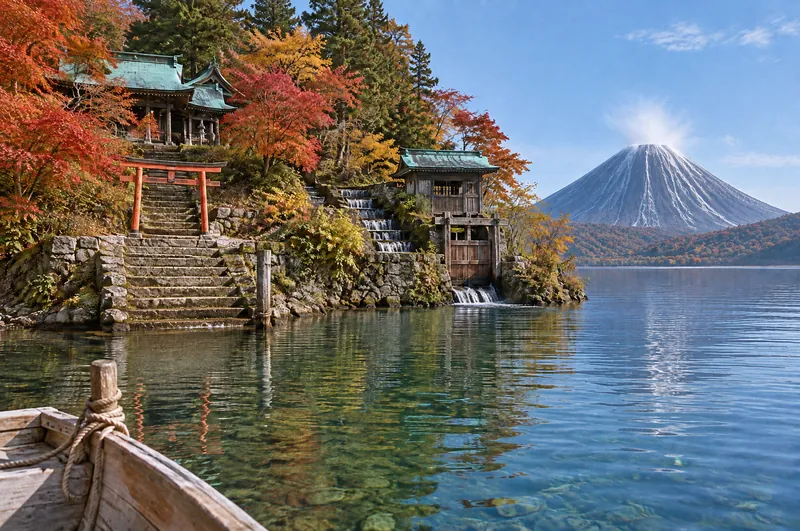
- Overview
- The water in the grounds
- The bucket basin and the autumn basin
- The sacred object: the Stopper
- The Mizunuki Festival
- Visiting the shrine
Overview
| Item | Details |
|---|---|
| Location | On the hill on the north shore of the Ring Lake, Kamimachi, Tokomizu Town |
| Deity | Mizurusu-no-Kami, a local god said to keep the water's place while it is away |
| Sacred object | The Stopper (tomesen), an old camphor-wood plug |
| Festival | The Mizunuki Festival (the day before the Draining in Kamimachi) |
| Autumn basin | From the morning of the Mizunuki Festival to the end of November |
The shrine's ceremonies are carried out by the shrine and the parishioners of Kamimachi. The town office looks after the canals, boat traffic and the safekeeping of goldfish on the festival day.
The water in the grounds
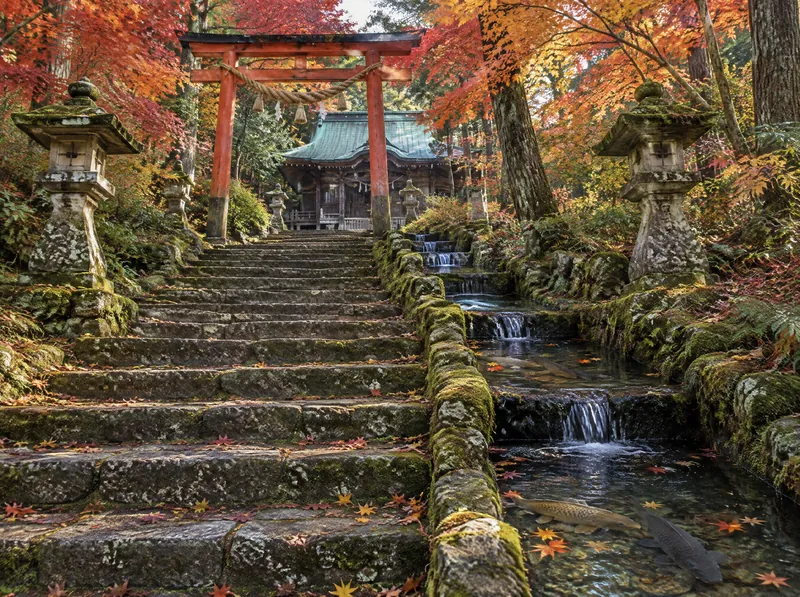
A small spring rises from the rock behind the hall of worship. It is said to be water running under Mount Mizufuji that comes to the surface in just this one place below the hill.
A bamboo pipe brings the spring water to the purification pavilion. The water that overflows the basin falls into a stone gutter at its foot, enters the purification canal beside the steps, and runs down from step to pool, step to pool, until it returns to the Ring Lake beside the boat landing at the foot of the hill.
Sacred carp (native carp found only in shrine canals and a few special waters) live in the pools of the purification canal. They are a different fish from household goldfish. The water in this canal is never stopped, even on the festival day.
The bucket basin and the autumn basin
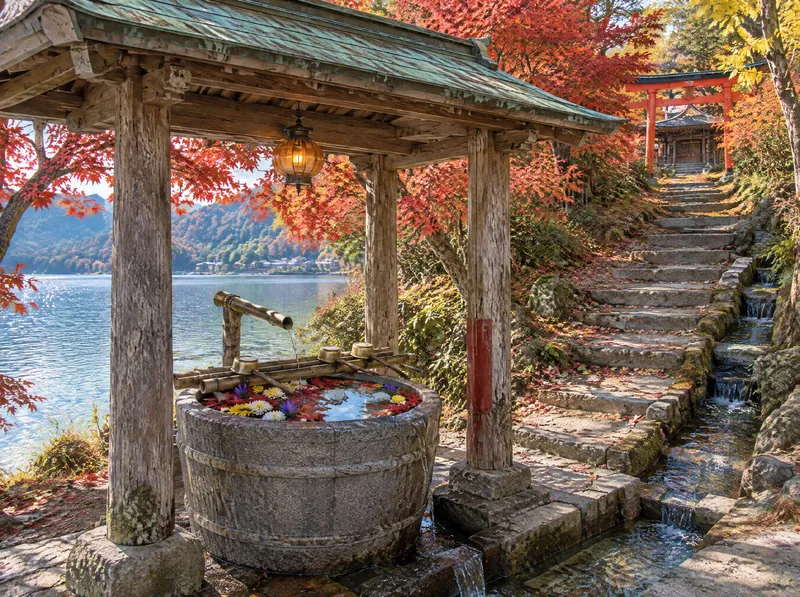
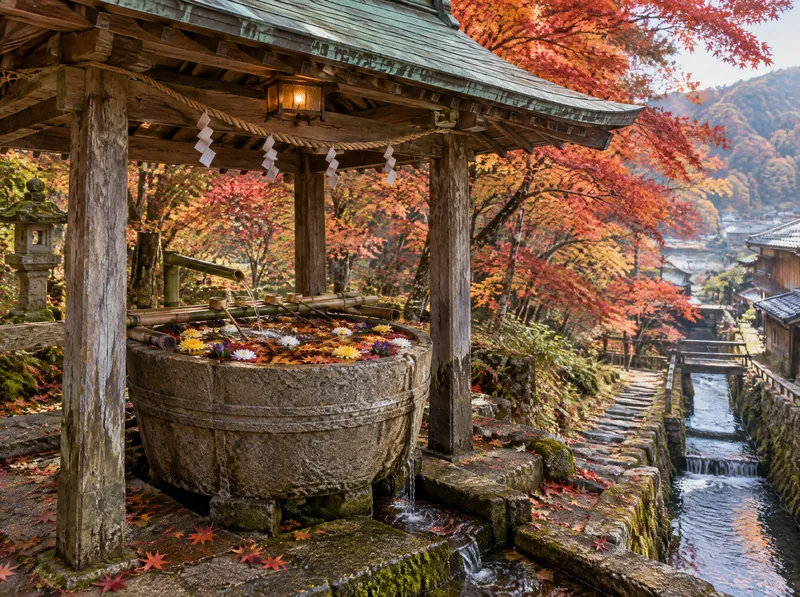
The purification pavilion stands halfway up the steps, just before the torii. Its basin was hollowed out of a single block of granite in the shape of a wooden bucket, with hoops carved around its body. Local people call it the bucket basin (oke-chōzu), and it is said to take its shape from the bucket-moving of the Mizunuki Festival.
One of the posts has an old splice, edged in red lacquer as the town's custom is. The ladles are brass.
The autumn basin
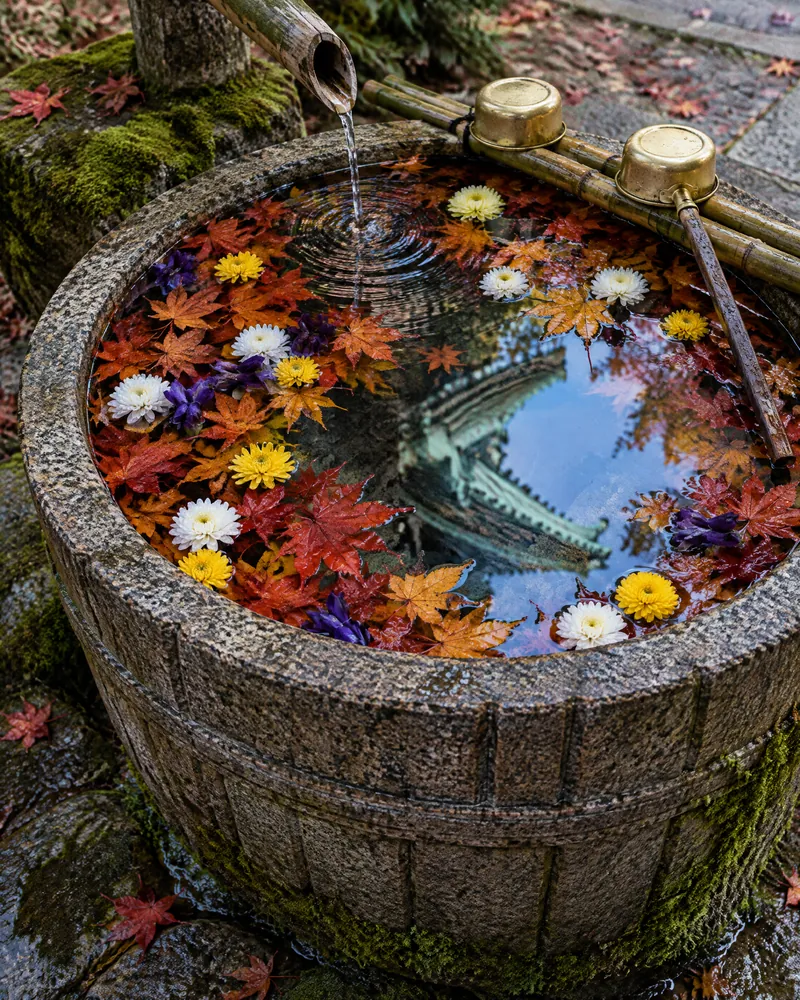
On the morning of the Mizunuki Festival, after the purification of the buckets, the surface of the basin is changed for autumn. Maple leaves, small chrysanthemums and gentians are floated on it, with a few ginkgo leaves. It stays that way until the winter preparations at the end of November.
The one rule for those who arrange the flowers is to leave a single clear space in the middle of the water. The green copper of the eaves and the sky are reflected there. In the evening, the glass lamp under the eaves is lit.
Please note
- Do not pour the water you scoop with the ladle back into the basin; let it run into the gutter at your feet. In the grounds they say, “Water you draw goes back to the canal.”
- Please do not release household goldfish into the basin or the purification canal.
- Please do not take home the flowers and leaves floating in the basin.
The sacred object: the Stopper
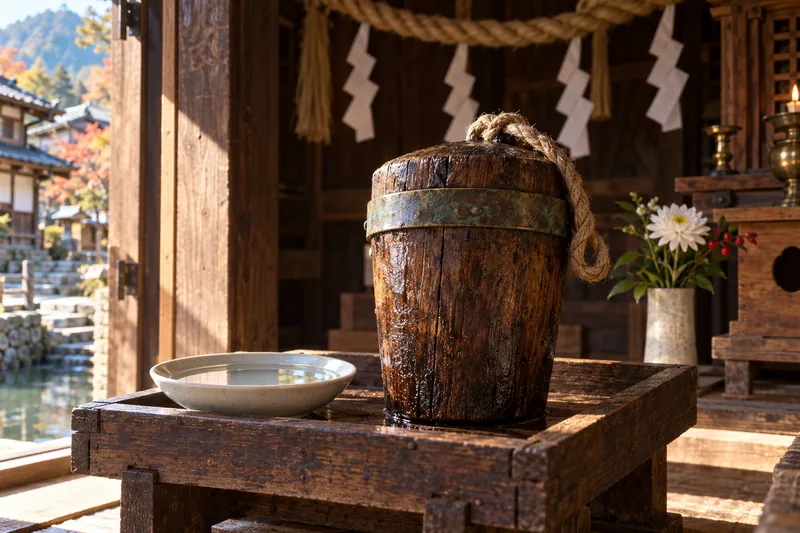
The sacred object is an old camphor-wood plug about 28 cm high, with a single bronze ring near its upper end.
The story goes that one autumn not long after the Great Rising, people cleaning a canal overlooked the goldfish in a small pool. A child who stayed behind blocked the outlet with this plug and called the grown-ups back. Since then, it is said, Kamimachi has always set someone to watch for what is left behind, apart from those who let the water out.
The Mizunuki Festival
The Mizunuki Festival is held on the day before the Draining in Kamimachi. Household goldfish are moved into buckets, and the water in the canals is asked to “make room for just one night”. In Chōwa 137 it was held on .
| Approximate time | Event |
|---|---|
| 7 a.m. | Raising the blind and purifying the buckets (the sacred object is shown, and the basin is changed to the autumn basin) |
| 9 a.m. | Welcoming the fish (households begin moving their goldfish into buckets) |
| 10 a.m.–noon | The Bucket Race |
| Noon–3 p.m. | The bucket road (the goldfish buckets are carried to the safekeeping station) |
| 4 p.m. | Counting and prize-giving |
| Around 5:30 p.m. | The Bucket-Return Dance |
| Around 7 p.m. | The rite of Leaving One Drop |
| Next morning | The Draining (the water wardens check that no fish are left, then let the water out) |
The Bucket Race
Contestants see how many goldfish they can move into a bucket in three minutes, using a shallow wooden bowl that scoops up fish and water together. The fish keepers do the counting. Only fish swimming happily are counted, and each bucket has a limit. The winner looks after the decorated “first bucket” for a year. Fish and money are never given as prizes.
Leaving One Drop
At night, water in a white dish is poured back little by little into another vessel, and the last drop is left beside the sacred object. It is said to mean that “even the work of emptying carries a duty to leave something”.
*On the festival day, boats may not use the small canal at the venue from 10 a.m. to noon. For the Draining that follows, see “Please help with the autumn canal cleaning (the Draining)” (Japanese).
Visiting the shrine
- By boat: boats can tie up at the landing at the foot of the hill. You can also take a tsujibune (a taxi boat).
- On foot: from the lakeside road in Kamimachi, pass through the torii at the boat landing and climb the steps.
- Please follow the shrine's notices in the grounds.
Information about the venue on the festival day is available from the Events Section of the Tourism Division.